20 minutes, 10 seconds
-6 Views 0 Comments 0 Likes 0 Reviews
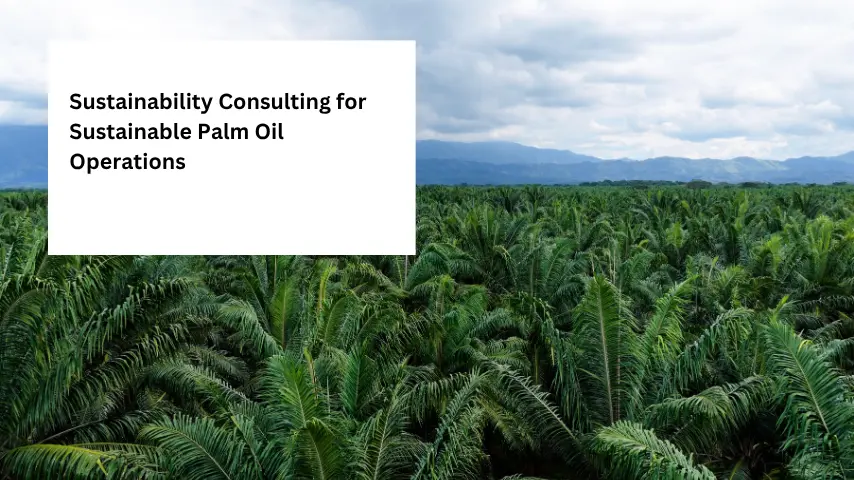
Sustainability consulting for sustainable palm oil operations focuses on the practical, on-the-ground changes that actually reduce a plantation or mill's environmental footprint — capturing methane from palm oil mill effluent instead of releasing it, protecting high conservation value and high carbon stock forest areas from clearing, eliminating open burning, and managing peatland responsibly — rather than the certification paperwork alone. Certification schemes such as MSPO and RSPO set the standards these operational practices are measured against, but the actual sustainability outcome depends entirely on whether a plantation or mill genuinely implements the underlying technical and operational changes, not merely whether it holds a valid certificate. This article looks specifically at what sustainable palm oil operations involve in practice, where the industry's most significant environmental gains are actually being made, and what consulting support for this operational work looks like distinct from certification consulting.
Sustainable palm oil operations means the specific, measurable practices a plantation and mill implement to reduce environmental and social impact — no deforestation policies that protect high conservation value and high carbon stock areas, no development on peatland alongside best management practices on existing peat plantations, a strict no-burning policy for land clearing, and no exploitation of workers, local communities, or smallholders (Bunge, 2026). These "no deforestation, no peat, no exploitation" commitments, commonly summarized across the industry as the "three no's," represent the operational substance that certification schemes are designed to verify, rather than being the certification itself.
A company's sustainability report can describe these commitments in detail, but the genuine test of sustainable operations lies in specifics: how many hectares of natural ecosystem are actively protected and monitored, whether peatland areas have documented management or restoration plans, and whether burning incidents are genuinely absent rather than simply unreported. One palm oil producer's sustainability disclosure, for instance, specifically details managing 100,000 hectares of natural ecosystems alongside its zero-burning and no-peat policies, illustrating the kind of concrete, quantified operational commitment that distinguishes genuine sustainable operations from a general statement of intent (AgNavigator, 2024).
High Conservation Value (HCV) and High Carbon Stock (HCS) areas are specific categories of land — biologically, ecologically, socially, or culturally significant areas, and forest areas storing significant amounts of carbon, respectively — that sustainable palm oil operations are expected to identify and protect from clearing during plantation development (Bunge, 2026). Operationally, this means a plantation company needs a genuine, technically conducted HCV/HCS assessment before any new land development, not just a policy statement referencing these categories in general terms, since these assessments determine specifically which parcels of land within a concession must remain untouched.
Palm oil mill effluent (POME) treatment functions as a central operational sustainability practice because POME — the highly acidic, nutrient-rich wastewater generated during palm oil processing — emits substantial methane when left in conventional open ponds, and capturing that methane through anaerobic digestion simultaneously prevents a potent greenhouse gas from escaping into the atmosphere while generating usable biogas energy that can power mill operations or be sold to the grid (World Economic Forum, 2026). This dual environmental-and-economic benefit is precisely why POME treatment has become one of the most widely adopted operational sustainability practices across the Malaysian palm oil industry specifically.
The measurable impact of this practice at an industry level is substantial: MSPO certification requirements combined with broader industry best practice adoption have contributed to a 68.8% reduction in the Malaysian palm oil industry's greenhouse gas emissions, achieved specifically through replacing fossil fuels with captured biogas energy and avoiding methane emissions that would otherwise have been released from untreated effluent (UkrAgroConsult, 2025). Roughly 28 cubic meters of methane can be produced per ton of POME processed through anaerobic digestion, representing a meaningful and quantifiable energy recovery opportunity that conventional open-pond treatment simply discards (ScienceDirect, 2025).
No, basic anaerobic digestion is not the only available approach, though it remains the most technologically mature POME valorization route; more advanced options include hybrid systems that improve effluent quality, energy recovery, and operational stability simultaneously, and nature-based solutions such as microalgae systems, floating macrophytes, and constructed wetlands, which offer low-energy polishing treatment though their performance remains sensitive to hydraulic and climatic variability (ScienceDirect, 2026). Some facilities have gone further still, implementing integrated "zero discharge" systems combining pretreatment, anaerobic and aerobic processing, and membrane separation, recovering over half of the waste oil content in raw POME for resale while treating the remaining effluent to a standard clean enough for reuse as boiler feed water (PMC, 2015).
Peatland management plays a central role in sustainable palm oil operations because peatland stores exceptionally large amounts of carbon, and disturbing or draining it for cultivation releases that stored carbon while also creating conditions considerably more prone to fire — meaning preventing new plantation development on peatland, and implementing peatland management systems on existing peat plantations to prevent fires and further emissions, are treated as distinct, high-priority operational practices within the broader sustainability framework (World Economic Forum, 2026). Where possible, active peat restoration is also implemented as part of a comprehensive peatland management approach, rather than simply limiting future development.
This focus on peatland specifically explains a documented performance gap between RSPO-certified and non-certified plantations: RSPO-certified operations typically emit less greenhouse gas than non-certified operations, and this difference is attributed substantially to certified members being less likely to plant on peat, alongside generally higher crop yields and more advanced methane capture technology for effluent treatment (World Economic Forum, 2026). This gap illustrates that certification, when genuinely implemented at the operational level, correlates with measurably better environmental outcomes — though the certification itself is a marker of underlying operational practice rather than the source of the improvement.
Peatland avoidance appears to be one of the more significant individual operational factors distinguishing higher- from lower-performing palm oil operations on greenhouse gas emissions specifically, alongside crop yield efficiency and methane capture technology, though all three factors work together rather than functioning as independent, isolated levers — a plantation with strong methane capture but ongoing peat development, for instance, would still carry a considerably higher overall emissions profile than one addressing all three areas together.
Sustainability consulting support offered by a top sustainability consultant such as Wellkinetics for palm oil operations involves technical assessment and implementation guidance across each of these specific practice areas — conducting or reviewing HCV/HCS assessments before land development decisions, evaluating and recommending appropriate POME treatment technology matched to a mill's specific scale and existing infrastructure, and designing peatland management or restoration plans for plantations operating on or near peat. This work is considerably more technical and engineering-oriented than the certification-focused consulting work covering MSPO, RSPO, and EUDR documentation, since it involves genuine environmental science, wastewater treatment engineering, and land assessment methodology rather than primarily compliance documentation and traceability systems.
Consultants supporting this operational work often need to evaluate a range of POME treatment technology options against a specific mill's context — comparing conventional open-pond treatment, anaerobic digestion with biogas capture, hybrid treatment systems, and nature-based solutions — since the right choice depends on factors including the mill's processing volume, existing infrastructure, available capital, and whether the priority is emissions reduction, energy generation, water quality compliance, or some combination of all three (ScienceDirect, 2026).
Yes, this operational consulting work connects directly back to certification requirements, since MSPO and RSPO both assess whether these underlying operational practices are genuinely in place — a plantation cannot pass a genuine MSPO or RSPO audit through documentation alone if its actual HCV protection, peatland management, and effluent treatment practices do not meet the standard's substantive requirements. Consultants working on operational implementation and consultants working on certification compliance are therefore addressing two sides of the same underlying reality, even though the specific technical skills each requires differ considerably.
Ongoing operational and environmental challenges remain even where these practices are actively implemented, since POME treatment specifically continues to face documented water quality issues — one water quality index study of sites near POME discharge found values indicating water unsuitable for potable use, with the poorest quality observed directly at the discharge point, highlighting that even treated effluent can continue adversely affecting nearby water bodies if treatment falls short of required standards (ResearchGate, 2026). This finding reinforces that "having a POME treatment system" and "operating a POME treatment system to a genuinely adequate standard" are two different things, requiring ongoing water quality monitoring rather than a one-time technology installation.
Similarly, even companies with strong documented zero-burning and no-peat policies can experience operational incidents that undermine those commitments — one Malaysian producer's sustainability report specifically acknowledged a non-compliance case involving the breaking of a POME pond embankment, illustrating that infrastructure failure remains a genuine operational risk even for companies with otherwise strong policy commitments, and reinforcing the need for ongoing infrastructure maintenance and monitoring rather than treating policy adoption as a completed task (AgNavigator, 2024).
No, companies should not expect perfect, permanent compliance once these operational systems are initially implemented, since ongoing monitoring, maintenance, and periodic technology upgrades remain necessary — infrastructure can fail, water quality standards can be missed even with active treatment in place, and evolving science may reveal that yesterday's best practice needs updating. Sustainability consulting engagements focused on genuine operational improvement, rather than one-time system installation, typically build in this ongoing monitoring and maintenance dimension explicitly.
The most common criticism of how sustainable palm oil operations are currently implemented is that meaningful technology and practices such as advanced POME treatment and rigorous HCV/HCS protection remain unevenly adopted across the industry, with RSPO-certified operations — covering only an estimated 19% of palm oil produced globally — demonstrating measurably better outcomes than the much larger non-certified segment of the industry, meaning the majority of global palm oil production still operates without the same verified operational standards (World Economic Forum, 2026). Critics also point specifically to the continued technology gap in POME treatment: while anaerobic digestion with biogas capture is the most mature valorization route available, its adoption still faces genuine barriers around scale-up costs and technoeconomic feasibility, meaning even willing operators do not always have straightforward access to the most effective available treatment technology (ScienceDirect, 2025).
Defenders of the industry's current trajectory point to the substantial, measurable emissions reductions already achieved — the documented 68.8% greenhouse gas reduction attributed specifically to fossil fuel replacement and methane avoidance in Malaysia's palm oil sector — as evidence that genuine operational progress is occurring at scale, even if universal adoption across every producer globally remains incomplete (UkrAgroConsult, 2025). The more balanced view is that the operational practices themselves are well-established and demonstrably effective where genuinely implemented, but consistent, industry-wide adoption — particularly among smaller and non-certified producers — remains the primary gap between the technology's proven potential and the sector's actual current environmental footprint.
Palm oil companies should prioritize operational sustainability investment based on their specific existing gaps and risk profile — a company still operating on or near peatland should prioritize peatland management and restoration planning given its outsized emissions impact, while a company with strong land-use practices but outdated open-pond effluent treatment should prioritize upgrading to anaerobic digestion with biogas capture, given both the emissions reduction and genuine energy cost offset this technology provides. Companies should resist treating all four "three no's" commitment areas as requiring identical investment, since a genuine gap analysis, informed by consulting expertise, typically reveals that one or two specific operational areas represent the company's most urgent and highest-impact improvement opportunity relative to its current baseline.
Given the documented ongoing challenges even for companies with mature operational systems in place — water quality issues persisting despite treatment, infrastructure failures undermining otherwise strong policy commitments — companies should also budget explicitly for ongoing monitoring and maintenance investment, rather than treating a POME treatment system or a peatland management plan as a completed, one-time capital project.
Genuine sustainability in palm oil operations rests on specific, technically demanding practices — HCV and HCS forest protection, peatland avoidance and restoration, zero-burning land clearing, and effective POME treatment with methane capture — that certification schemes measure but do not themselves create, meaning consulting support focused on the underlying operational and engineering reality is distinct from, though closely connected to, certification-focused consulting. Palm oil companies that invest in genuine operational implementation across these specific practice areas, supported by consulting expertise matched to the technical demands of each — environmental assessment, wastewater engineering, peatland science — are the ones producing the measurable emissions reductions the industry has already demonstrated are achievable at scale, rather than operations where certification exists as a credential disconnected from genuine on-the-ground practice.

Choose a test user to login.







Share this page with your family and friends.